



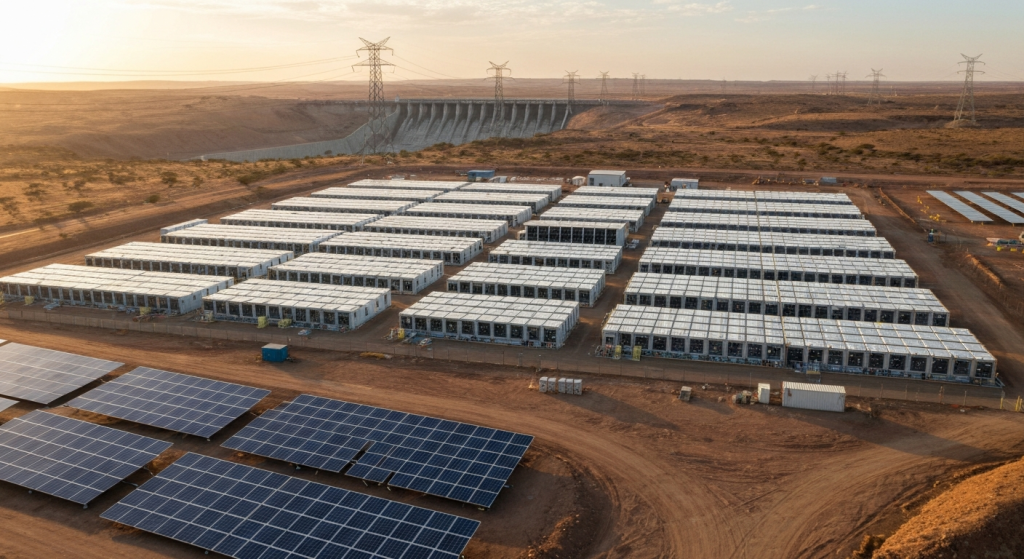


Western Bitcoin miners have spent the last decade chasing cheap power in North America and Northern Europe. Iceland, Quebec, Kentucky, Texas. The formula was simple: low electricity costs, reliable grid, established rule of law.
That formula still works. But the margin is getting thin.
Average US industrial power sits around $0.07/kWh. After taxes, hosting fees, and pool costs, a miner running a new-generation ASIC at 21 J/TH needs BTC above $70,000 to stay comfortably in profit. At $0.05 or below, that floor drops dramatically.
Africa has power at $0.03 to $0.05/kWh across multiple jurisdictions. That gap is not a rounding error.
Where the power is and why it is cheap
Ethiopia is the clearest example. The Grand Ethiopian Renaissance Dam now produces over 5,000 MW, with another 6,000 MW of hydro capacity in development. The country’s grid is underbuilt relative to its generation capacity. That surplus is exactly what Bitcoin mining absorbs well.
Luxor’s Q2 2026 heatmap ranked Ethiopia eighth globally for hashrate contribution, up from outside the top fifteen a year ago. The trajectory is steep.
Mozambique is a different story but the same logic. Cahora Bassa on the Zambezi produces around 2,100 MW. The PPA rates available to industrial energy buyers are among the lowest on the continent. Grid transmission is a constraint, which is actually why stranded-site mining makes sense: put the machines at the generation point and skip the transmission problem entirely.
Beyond those two, Zambia, DRC, and Tanzania all have hydro resources that are either underdeveloped or delivering into grids that do not have the industrial demand to absorb them. The surplus has to go somewhere.
The risks are real and specific
Western investors hear Africa and think political risk, currency risk, and infrastructure failure. Some of that is valid. Some of it is outdated.
The real risks are specific:
Grid stability varies by country and even by region within a country. Ethiopia’s national grid is less reliable than its generation capacity suggests, because transmission infrastructure has not kept pace. Miners building at the dam site sidestep this. Miners plugging into the national grid downstream do not.
Regulatory clarity is improving but uneven. Ethiopia passed pro-mining legislation in 2023. Mozambique is earlier in that process. Zambia has shown interest but no formal framework yet.
Currency and repatriation rules matter. Bitcoin mining revenue is denominated in BTC, which helps. But operational costs are in local currency, and moving profits offshore requires navigating foreign exchange controls that differ country by country.
What the numbers look like in practice
A 1 MW operation in Texas at $0.07/kWh runs about $504,000 per year in electricity costs.
That same 1 MW at an Ethiopian hydro site at $0.04/kWh: roughly $288,000 per year.
The $216,000 annual savings at 1 MW is meaningful. At 10 MW it becomes the entire profit or loss column.
For a Western investor evaluating Africa as a mining location, the question is not whether the power advantage is real. It is. The question is whether the operational structure can capture it reliably: local partnerships, grid connection agreements, regulatory positioning, and custody of the machines.
The takeaway
Africa’s power advantage is structural, not cyclical. It is built on hydro surplus that will not disappear when BTC price swings. The investors who position correctly in the next 24 months will have a cost base that most North American and European miners cannot match.
The risk is in execution, not in the thesis. Get the right local partners, understand the specific country’s regulatory environment, and do not conflate the continent with a single risk profile. Ethiopia, Mozambique, and Zambia are three very different operating environments.
The opportunity is real. The work to capture it is also real.