



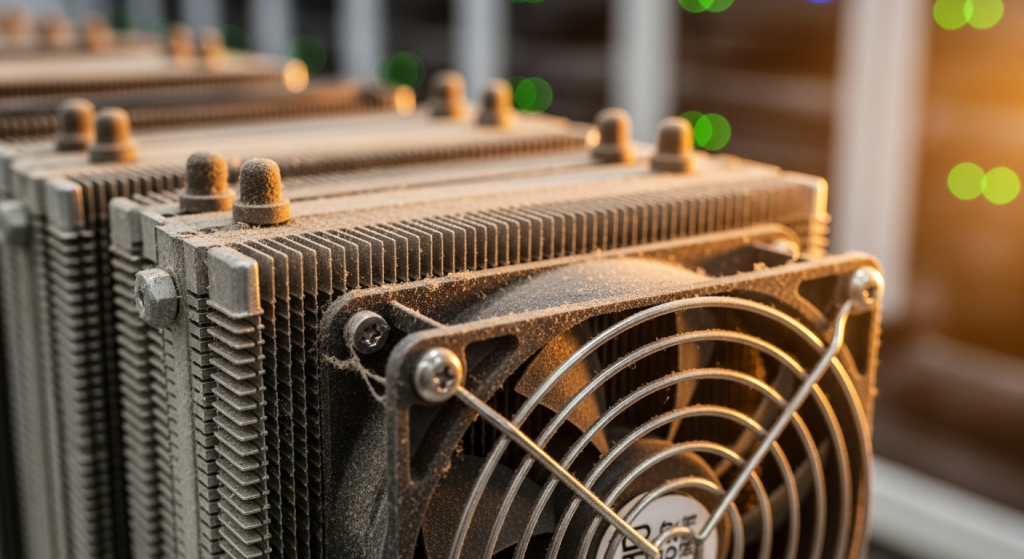


ASIC Depreciation: The Hidden Cost Most Miners Ignore

Most miners track electricity costs carefully. Few track ASIC depreciation. Here is how this hidden capital cost quietly erodes mining returns.
Jesse Pielke

Share

When miners calculate profitability, they usually focus on three numbers: the electricity rate, the Bitcoin price, and the hashrate. Those are visible. They show up in dashboards.

What doesn’t appear in most spreadsheets is depreciation. And it’s quietly eroding returns.

What depreciation actually means for ASICs

An ASIC is not a forever asset. It’s a machine with a market price that falls over time, driven by two forces: hardware wear and the constant release of newer, more efficient models.

A Bitmain S19j Pro running at 100 TH/s with 29.5 J/TH was worth around $6,000 at peak in 2021. Today that same machine trades for under $400. The machine didn’t stop working. The market moved past it.

That delta matters enormously when calculating your actual return on capital.

The depreciation problem in numbers

Say you buy a mid-tier miner today for $2,000 with a 24 J/TH efficiency. You lock into a 3-year hosting contract at $0.075/kWh.

Over 36 months, you’re generating BTC revenue and your electricity cost is predictable. But your machine is not worth $2,000 at month 36. It’s worth closer to $400 to $600, assuming no major difficulty spike forces weaker machines offline first.

That $1,400 to $1,600 in value destruction needs to appear somewhere in your math. It doesn’t disappear.

Annualised, that’s roughly $467 to $533 in depreciation per machine per year, before accounting for any BTC price movement.

Why this gets ignored

A few reasons. Most miners think in yield terms: how much BTC am I generating each month? Depreciation is a capital cost, not a cash cost, so it doesn’t hit the wallet directly.

There’s also an optimism bias. People assume their machine will hold value better than historical averages because “Bitcoin is going up.” That may hold in BTC-denominated terms during a bull run, but in fiat terms, ASIC prices have a consistent tendency to fall regardless of market cycle.

And honestly, the industry mostly talks to itself. Forums cover hashprice and pool fees. Depreciation makes the numbers look worse, so it gets underweighted.

The machines that depreciate slowest

Not all ASICs age equally. The pattern is consistent: the most efficient machines on the market at any point in time hold value longest.

The 2026 efficiency leaders have moved well past the previous generation. Bitdeer’s SEALMiner A4 Pro runs at 10.9 J/TH, and their A4 Ultra Hydro pushes below 10 J/TH. Bitmain’s S21 XP sits at 13.5 J/TH. The S21 standard and MicroBT’s M66S, once considered top-tier at 16 to 18 J/TH, are already sliding into mid-tier territory. Anything above 25 J/TH is on borrowed time. Machines in the 18 to 22 J/TH range will still run profitably at most hosting rates right now, but one efficiency generation from now, they become stranded assets.

The best hedge against depreciation is buying efficiency headroom. Not the cheapest machine available today, but the one that will still be competitive two generations out.

What to do with this

Build depreciation into your ROI model from day one. A simple approach: estimate the machine’s residual value in 24 to 36 months (typically 25 to 30% of purchase price for mid-tier hardware), subtract that from the purchase price, and spread the loss across your holding period.

That’s your true cost of capital alongside electricity. When you run those numbers, some deals that looked solid at 5 to 6 cents/kWh start looking thin.

It also changes how you think about used hardware. A machine at 50% of new price may still depreciate at 80% of the new machine’s pace if it’s already mid-tier on efficiency. The discount doesn’t always compensate for the shorter runway.

The miners who survive across cycles are the ones who treat their machines like any other depreciating asset: tracked, modelled, and replaced at the right time.

Depreciation is one piece of a bigger question: what does it actually cost to mine a Bitcoin today? We will break that down in a follow-up post, covering power, hosting, pool fees, and depreciation combined into one all-in cost per BTC.

We use cookies to personalise content and ads, to provide social media features and to analyse our traffic. We also share information about your use of our site with our social media, advertising and analytics partners. View more
Cookies settings
Accept
Privacy & Cookie policy
Privacy & Cookies policy
Cookie name Active

Who we are

Suggested text: Our website address is: http://hashrateup.local.

Comments

Suggested text: When visitors leave comments on the site we collect the data shown in the comments form, and also the visitor’s IP address and browser user agent string to help spam detection.

An anonymized string created from your email address (also called a hash) may be provided to the Gravatar service to see if you are using it. The Gravatar service privacy policy is available here: https://automattic.com/privacy/. After approval of your comment, your profile picture is visible to the public in the context of your comment.

Media

Suggested text: If you upload images to the website, you should avoid uploading images with embedded location data (EXIF GPS) included. Visitors to the website can download and extract any location data from images on the website.

Cookies

Suggested text: If you leave a comment on our site you may opt-in to saving your name, email address and website in cookies. These are for your convenience so that you do not have to fill in your details again when you leave another comment. These cookies will last for one year.

If you visit our login page, we will set a temporary cookie to determine if your browser accepts cookies. This cookie contains no personal data and is discarded when you close your browser.

When you log in, we will also set up several cookies to save your login information and your screen display choices. Login cookies last for two days, and screen options cookies last for a year. If you select "Remember Me", your login will persist for two weeks. If you log out of your account, the login cookies will be removed.

If you edit or publish an article, an additional cookie will be saved in your browser. This cookie includes no personal data and simply indicates the post ID of the article you just edited. It expires after 1 day.

Embedded content from other websites

Suggested text: Articles on this site may include embedded content (e.g. videos, images, articles, etc.). Embedded content from other websites behaves in the exact same way as if the visitor has visited the other website.

These websites may collect data about you, use cookies, embed additional third-party tracking, and monitor your interaction with that embedded content, including tracking your interaction with the embedded content if you have an account and are logged in to that website.

Who we share your data with

Suggested text: If you request a password reset, your IP address will be included in the reset email.

How long we retain your data

Suggested text: If you leave a comment, the comment and its metadata are retained indefinitely. This is so we can recognize and approve any follow-up comments automatically instead of holding them in a moderation queue.

For users that register on our website (if any), we also store the personal information they provide in their user profile. All users can see, edit, or delete their personal information at any time (except they cannot change their username). Website administrators can also see and edit that information.

What rights you have over your data

Suggested text: If you have an account on this site, or have left comments, you can request to receive an exported file of the personal data we hold about you, including any data you have provided to us. You can also request that we erase any personal data we hold about you. This does not include any data we are obliged to keep for administrative, legal, or security purposes.

Where your data is sent

Suggested text: Visitor comments may be checked through an automated spam detection service.

Save settings
Cookies settings
opportunity enquiry

Enquire about a opportunity

miner enquiry

Enquire about a miner

lets get started

Schedule a call with Jesse

Google reCaptcha: Invalid site key.