





Mining economics come down to one variable more than any other: the cost of power. When a miner can access electricity at $0.02-0.03/kWh instead of the global industrial average of $0.08-0.12/kWh, the math changes completely. The operations that survive downturns and thrive in bull markets are almost always the ones that solved the power cost problem first.
That solution usually involves stranded energy.
What “stranded” actually means
Stranded energy is power that exists but cannot easily reach its market. It is produced in places too remote for transmission lines, generated during off-peak hours when demand is low, or comes from sources that cannot store their output. For decades, this energy was either wasted or sold at a loss.
Take hydroelectric power in a river valley. A dam in Ethiopia or Paraguay can produce gigawatts of clean electricity, but if there is no nearby city and the transmission infrastructure to reach one costs hundreds of millions of dollars, the power has no buyer. It either gets curtailed (simply wasted) or sold to the national grid at prices that barely cover operating costs.
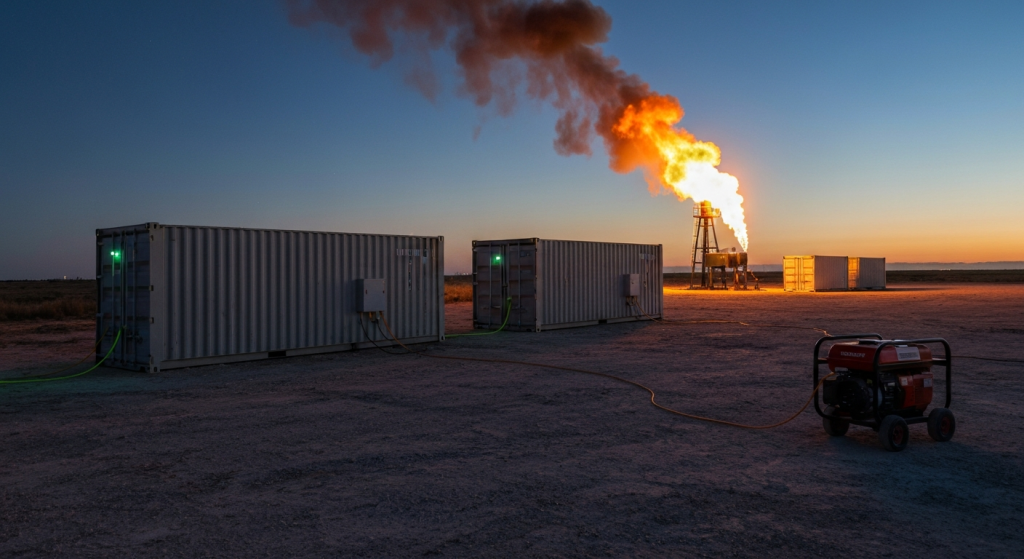
Flare gas is another example. Oil wells produce natural gas as a byproduct of extraction. Without a pipeline nearby, operators vent or burn it. The World Bank estimates over 140 billion cubic meters of gas are flared globally each year. That is roughly equivalent to the total electricity consumption of sub-Saharan Africa, going up in smoke.
In both cases, the energy exists. It just has no buyer willing to show up at the source.
Why Bitcoin mining fits so well
Bitcoin miners are flexible in ways almost no other industrial buyer is. A mining operation inside a shipping container can be deployed in months, not years. It runs 24/7, providing the baseload demand that stranded power sources need. And it can shut off during grid stress events without losing a product or disrupting a supply chain.
This combination makes miners ideal anchor tenants for otherwise unsellable power. A hydroelectric project in rural Ethiopia can contract power to a mining operation at $0.02/kWh and still generate revenue that would not exist otherwise. The miner gets cheap power. The energy producer gets a buyer. The power that would have been wasted gets monetized.
The actual numbers
Paraguay has been quietly selling excess capacity from the Itaipu dam, one of the largest hydroelectric projects in the world, to mining operations at rates reportedly below $0.02/kWh. That pricing has drawn significant investment despite the country’s relatively modest infrastructure.
Ethiopia’s Grand Ethiopian Renaissance Dam creates similar dynamics. With 6,000+ MW of generating capacity and limited domestic industrial demand at launch, power pricing for large buyers has been aggressive. Several mining operators have established operations in Ethiopia specifically because of this window.
In North America, flare gas mining operations in the Permian Basin run at effective power costs of $0.01-0.025/kWh. The gas was going to be burned anyway. The miner monetizes it and the oil company reduces its flaring footprint.
What the power cost difference actually means
A miner running a modern ASIC at $0.04/kWh pays roughly $10-12 per day in electricity at current network difficulty. At $0.02/kWh, that drops to $5-6 per day. That $5 gap per machine compresses margins for one miner and creates them for the other.
Multiply that across a 5-megawatt facility running a few thousand machines, and the cost difference becomes tens of thousands of dollars per day. Over a bear market that drags 18 months, stranded energy miners survive while grid-power miners turn off or sell equipment at a loss.
The cost floor is what separates operations that endure from ones that do not.
The practical takeaway
When evaluating a mining operation or hosting provider, ask directly where the power comes from and at what rate. “We use renewable energy” is marketing copy. “We pay $0.025/kWh at a run-of-river hydro project under a 5-year offtake agreement” is substance.
Stranded energy is not a gimmick or a talking point. It is the single biggest structural advantage any mining operation can hold. Operations built on it can weather hashprice compression, difficulty spikes, and bear markets that wipe out competitors running on standard grid power.
Find the operations built on stranded energy. Everything else in the analysis follows from there.